Or if you want to tie your studies in with a historical event, how about Picture Book Explorers ~ The Little Ships which covers the Dunkirk evacuations of World War II in May- June 1940?
This year, my children will be taking part in the CILIPShadowing Scheme organised by our local library to follow the Kate Greenaway Award. They will be looking at this year's shortlisted books, writing reviews, researching the artists, designing their own covers and voting for a group winner using the same criteria as the real judges.
The Kate Greenaway Medal was established in 1955 and is awarded for distinguished illustration in a children's book. It has had some well-known winners in the past, such as Helen Oxenbury, Shirley Hughes and Quentin Blake. Librarians select a short-list from the many books submitted and follow strict judging criteria to decide the winner.
Not all the selected picture books are aimed at young children, in fact there are three aimed at the 10+ age group. Older children love picture books too :) This year's shortlist is:
You can shadow the award in your own family and set up an account on the CILIP website. TYour children will be able to submit their own work and post their own reviews. There are free resources available too :)
The Kate Greenaway Award runs alongside the Carnegie Award, Britain's longest running and most prestigious children's book award. You can see all the past winners of the Kate Greenaway Medal here. How many have you read?
How appropriate that National Libraries Day should come at the end of National Storytelling Week :) You can join in by tweeting photos using #shelfies and share your love of libraries with #NLD15
In my family, we use libraries very regularly. These days they seem to offer so much more than just the lending of books with regular storytelling sessions, games clubs, school holiday activities, internet sessions, talks and reading groups.
We're blessed to have a local library in our village with friendly and helpful staff. I find the threat of library closures depressing, especially knowing that our little local library is well used by the different generations and by people from all walks of life.
I have always used libraries. As a child, the library gave me access to whole series of books one after the other, without having to wait for birthdays or Christmas to get the next one. As a teenager, came access to the adult section which opened my eyes to history and many new and wonderful topics. As mum with young children, it was joy to go and let them choose their own books and I read many, many picture books with them and we all made new friends at storytelling sessions. As a student, it was so easy to go and pick up a book that 'might' be useful for an assignment without having to worry that it was wasted money. And now as a writer, I borrow piles and piles of picture books trying to find ones that will introduce new areas of interest to my children and yours through Picture Book Explorers.
I'd love to hear what your local library offers beyond books. Is it different in other parts of the country, and in other parts of the world. I'm in Yorkshire, England. Please tell me about your local library in the comments :)
This week is the 15th annual National Storytelling Week in the UK running from 31st January until 7th February which also happens to be National Libraries Day :)
Why is storytelling so important that it deserves a whole week?
"Storytelling and reading aloud are powerful tools for a child's development, and for sparking a lifelong love of books:
Reading aloud is shown to be the most important thing you can do to help prepare a child for reading and learning
The more words a child hears spoken to them, the more words they learn
Reading aloud ... opens up new worlds to children and demonstrates the joy of reading."
Scholastic Books
There are a few literature-rich curricular from America that already know the benefits of reading aloud to children. Along with good quality children's literature from the last couple of centuries, many will recommend books of fairy tales, folk tales and other stories that originated from an older oral tradition.
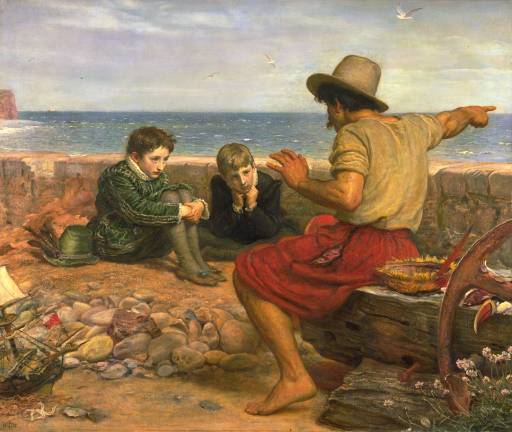
Charlotte Mason was a British educator. Her method goes a step beyond reading aloud by encouraging narration, primarily to develop skills needed for composition writing. One means of narration can be as simple as a child retelling the main points of a story they have just heard, leading to a more in depth retelling by an older child, that in our house sometimes borders on a dramatic production. In this way, narration also develops and encourages the storytelling skills that people have enjoyed for millenia.
"The Boyhood of Raleigh" by John Everett Millais 1870
National Storytelling Week is a celebration of the oral tradition organised by the Society for Storytelling. You can find a list of events here.
If you're on twitter use #NationalStorytellingWeek to join the National Story Week conversation and #picturebookexplorers to share your stories of using Picture Book Explorers to encourage storytelling :)
"Reading aloud with children is known to be the single most important activity for building the knowledge and skills they will eventually require for learning to read." - Marilyn Jager Adams
Today is National Read Aloud Day in Kenya :) This event place annually on the last Friday of January.
In Kenya, they have 20,000 primary schools without libraries, so events like this can have a significant impact on the children. It's an event organised by Start a Library whose aim is to put a book in every hand. They select an extract from a particular book which is read at 9am in schools and libraries across the country. The book they have selected deals with issues particular to the region.
If you want to join in and read the extract that will be read in Kenya, you can buy the book Attack of the Shidas
on Kindle. The Kenyan schools and libraries will be reading an extract from the back of the book and the children will be asked to write their own ending to the story or draw an illustration.
You could celebrate Kenyan national Read Aloud Day too by reading books about Kenya.
Here are some suggestions:




 on Kindle. The Kenyan schools and libraries will be reading an extract from the back of the book and the children will be asked to write their own ending to the story or draw an illustration.

